

Climate Variability and Cocoa Farmers’ Livelihoods in Idanre and Odigbo Local Government Areas of Ondo State, Nigeria
Article Sidebar
Main Article Content
Abstract
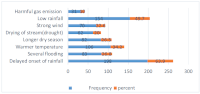
Cocoa production, which used to be the mainstay of Nigeria’s economy, had suffered a serious setback in the recent past due to some factors among which is climate variability. This study aims at examining climate variability’s effect on cocoa farmers’ livelihoods in Ondo State, Nigeria. Multistage sampling techniques was used to sample 310 cocoa farmers in the study areas and data were collected using structured questionnaire to elicit information from cocoa farmers on their enterprise characteristics, awareness of climate variability, exposure to climate variability, and its effects on cocoa farmers’ livelihoods. Data collected were analyzed and interpreted using descriptive statistics (such as mean, frequency counts, standard deviation, and percentages) and regression at p=0.05. Awareness of climate variation trends was highest for delayed onsets of rainfall (63.9%) and lowest for harmful gas emission (10.0%). Overall, awareness was high among 52.3 % of the farmers. Exposures to climate parameters were perceived to be highest in terms of temperature, incidences of soil erosion and mudslide. Negative impact of climate change on cocoa farmers’ livelihoods was pronounced in terms of poor quality of produce (4.7±0.7), low yield (4.2±0.6) and reduced size of land cultivated (4.3±0.9). The impacts were perceived as high among 51.3% of the farmers. Integrated pest management (3.6±0.8) and use of fertilizer (3.4±0.7) were major adaptation measures used. The study concludes that climate change variability has moderate impact on cocoa farmers’ livelihood in the study area. Impact on livelihood is more felt by larger households than smaller ones. It is recommended that improved awareness of climate-smart farming practices will reduce impact felt among cocoa farmers.
Downloads
Article Details

This work is licensed under a Creative Commons Attribution-NonCommercial-ShareAlike 4.0 International License.
How to Cite
References
Approach, International Journal of Research in Agriculture and Forestry, Vol. 4 Issue 12, pp. 33-37
Oyekale, A. (2009). Climatic variability and its impacts on agricultural income and household’s welfare in Southern and Northern Nigeria. Electronic Journal of Environmental Agricultural and Food Chemistry. 8(1), 13 – 34.
Sanusi, J. O. (1988). Deregulating the Nigerian Economy: Achievement and Prospects. Economic and Financial Review. 26(4), 32 – 46.
Sanusi, R. A. & Oluyole, K. A. (2005). An analysis of cocoa production and export in Nigeria (1930 - 2003). Bulletin of science Association of Nigeria. Vol. 6, 146 – 154.
Tirfe, A. G. (2014). Smallholder farmers’ innovation and its determinants: the case of Hirity Mekan Seed Producers’ Cooperative, Tigray, Ethiopia. Developing Country Studies, 4(21), 104-115.
J. O. (2004): Climate change: A synopsis of its Nature, Causes, Effects and Management. Ibadan: Vantage Publishers Ltd.
Bradshaw, B., Dollan, H. and Barry, S. (2004): Farm –Level Adaptation to Climatic variability and change: Crop Diversification in the Canadian Prairies. Climatic Change, 67:119-141.
Central Bank of Nigeria (1998): Annual Report and Statement of Account. http://www.cenbank.org
Enete, A.A. and Amusa, T.A. (2010). “Challenges of Agricultural Adaptation to Climate Change in Nigeria: A Synthesis from the Literature”, Field Actions Science Reports [Online], Vol. 4: 1-55. http://factsreports.revues.org/678.ss
Fadairo O. S. Williams P. A. Nalwanga F. S. (2019). Perceived Livelihood Impacts and Adaptation of Vegetable Farmers to Climate Variability and Change in Selected Sites from Ghana, Uganda and Nigeria. Environment, Development and Sustainability, Vol. 21:1-19
Fadairo, O. S., Olajuyigbe, S. O., Osayomi, T. O., Adelakun, O. E., Olanrewaju O., Olutegbe, S. and Adeleke, O. (2021). Climate Change, Rural Livelihoods and Ecosystem Nexus: Forest Communities in Agroecological zones of Nigeria. In: Leal Filho W., Ogugu N., Adelake L., Ayal D., da Silva I. (Eds.) African Handbook of Climate Change Adaptation. Cham: Springer. ISBN 978-3-030-45105-9. 1169-1192pp.
Falola, A. and Achem, B. A. (2017). Perceptions on climate change and adaptation strategies among sweet potato farming households in Kwara State, North Central Nigeria. Global Journal of Science.46(3), 55 – 63.
Gockowski, J., Afani-sefa, V., Sarping, D. B., Osei-Asare, Y. B. and Agyeman, N. F. (2013). Improving the productivity and income of Ghanaian cocoa farmers while maintaining environmental services: What role for certification. International Journal of Agricultural Sustainability. 2(4), 331 -346.
Intergovernmental Panel on Climate Change (2001): Changing Climate Change and Adaptation Process.
Washington D.C Intergovernmental Panel on Climate Change (2007): The Physical Science Basis (Summary for Policy Makers).
Intergovernmental Panel on Climate Change (2007): Climate Change: Synthesis Report. Contributions of Working Groups i, ii, iii to the Fourth Assessment Report of the Intergovernmental Panel on Climate Change: IPCC, Geneva.
Jiri, O., Mafongoya, P. and Chivenge, P. (2015): Smallholder Farmer Perceptions on Climate Change and variability: A Predisposition for their subsequent Adaptation Strategies. Journal of Earth, Science & Climatic Change. Vol. 6 (5): 277. ISSN:2157-7617.
Ladele, A. A., & Fadairo, O. S. (2013). Official corruption and sharp practices as impediments to transforming smallholders to agribusiness: Lessons from agricultural development interventions in Nigeria. Nigerian Journal of Rural Sociology, 14(1), 41-48.
Martey, E. and Kuwornu, k. M. (2021). Perceptions of climate variability and soil fertility management choices among smallholder farmers in Northern Ghana. Ecological Economics. Vol. 180.
Mase, A. S., Gramig, B. M., & Prokopy, L. S. (2016). Climate change beliefs, risk perceptions, and adaptation. Climate Risk Management, 1-10.
Ngigi, S. N. (2009). Climate change adaptation strategies: water resources management options for smallholder farming systems in SubSaharan Africa. The Earth Institute at Columbia University, New York.
Nwachukwu, I. N., Agwu, N., Nwaru, J., & Imonikhe, G. (2010). Competitiveness and determinants of cocoa export from Nigeria. Report and Opinion, 2(7), 5154.
Olajide A. O. (2021). Perspectives of Agricultural Commercialization: A Survey of Nigeria’s Cocoa Sector. Margraf Publishers ISBN 978-3-8236-1803-4
Olayide, S. O. and Falusi, A. (1975): Economics of Cocoa Production. In Proceedings of International Cocoa Research Conference, Ibadan, Nigeria, pp. 12-17.
Oluyole, K. A. (2010). The effect of weather on cocoa production in different Agroecological zones in Nigeria. World Journal of Agric. Sciences. 6(5), 609 – 614.
Oluyole, K. A. (2017). Competitiveness and comparative Advantage of Cocoa Production in Southwestern Nigeria, A policy Analysis